Tornado Survivor Finds Dog  

Posted by — Kim in , , , , , , , , , , , , , , ,

Here's a sweet miraculous story of hope during an Oklahoma tornado... –Kim

Tornado Survivor Finds Dog During TV Interview


Miraculous stories of survival emerge after one of the strongest tornadoes in history tore through an Oklahoma suburb.

An elderly woman whose home was destroyed by the Oklahoma tornado found her pet dog among the rubble during a live TV interview.

The footage of Barbara Garcia came as fellow survivors began reliving the terror they felt while winds of up to 200mph obliterated their neighbourhoods.

Mrs. Garcia was standing among the twisted wreckage of her home as she was interviewed about her experiences by a reporter from CBS.

video

"I was sitting on the stool holding my dog," she said.

"This was the game plan all through the years, to go in that little bathroom (together in an emergency). I rolled around a little bit and when it stopped – I was right there (and) that stove cooker is what I saw.

"I never lost consciousness, and I hollered for my little dog and he didn't answer, he didn't come. So, I know he's in here somewhere."

But as she spoke, a member of the camera crew spotted a dog's head poking out of the twisted remains of her home.

Mrs. Garcia is seen crouching down before exclaiming with joy as she spots her pet.

"Well, I thought God just answered one prayer to let me be OK, but He answered both of them, because this was my second prayer," she said, before being led away from the ruins with her dog.

Meanwhile, one mother who survived the storm described how she and her children took refuge in their bath as the tornado tore their house apart.

"My husband told us to get in the bathtub immediately and put on a mattress," she said.

She said she had to hold her daughter's hair to stop her slipping away when the tornado struck.

Another family locked themselves inside their cellar – only to have its door ripped open by the twister.

Ricky Stover said: "We thought we'd die. We saw the latch coming undone and we couldn't reach for it ... glass and debris started slamming on us."

Source: http://news.sky.com/story/1093711/tornado-survivor-finds-dog-during-tv-interview
Copyright ©2013 BSkyB

Digg Technorati Delicious StumbleUpon Reddit BlinkList Furl Mixx Facebook Google Bookmark Yahoo
Read more...

How to Train Your Dog at Home  

Posted by — Kim in , , , , , , , ,

Valuable Resource...

How to Easily Train Your Dog...
Like a Pro

It's essential for dog parents like you to know certain basic factors that determine your relationship with your dog and can go a long way in training him effectively.

Before you begin training your dog, it is absolutely essential that you build a loving bond with him. This is important as it helps you to understand his needs and instincts and also allows your dog to have complete trust in you.

Let's see how.......

How To Bond With Your Dog
Building a bond with your dog is the first and the most crucial step involved in training him successfully. As soon as you bring your dog home, you must first try to develop a caring and loving relationship with him in order to win his trust and confidence.


When dogs are secure in the knowledge that they belong to the family, they are more likely to respond better to their owners' training commands. Just like with any relationship, there must be mutual trust and respect between you and your dog.

Trust takes time to develop and respect comes from defining boundaries and treating any breach of those boundaries with firmness and fairness.

Without enforceable limitations, respect can’t be developed. And when there is no respect, building a bond with your dog is almost impossible.

Four Golden Rules to Building a Relationship with Your Dog:
  • Spend quality time together;
  • Take him out in the world and experience life together;
  • Establish and promote a level of mutual respect; and
  • Develop a way of communicating to understand each other's needs.
Building a bond with your dog will not only help you manage him better but will also make your dog calm, quiet and an extremely well-adjusted pet.

Love your dog and he will love you back!

When you're successful in building a bond with your dog, you can rest assured that training him and teaching him new and clever tricks will be a cakewalk.

Learn how to bond with your dog with this free mini course.

How Your Dog Learns...
Your dog's learning period can be divided into five phases:


The Teaching Phase – This is the phase where you must physically demonstrate to your Dog exactly what you want him to do.

The Practicing Phase – Practice makes Perfect. When a lesson is learned, practice with your dog what you have just taught him.

The Generalizing Phase – Here you must continue practicing with your dog in different locations and in an environment with a few distractions. You can take your dog out for a walk, or to a nearby park and command him to practice whatever you've taught him.

Practicing the learned lessons in multiple locations and in the presence of small distractions will help him learn and retain lessons better.

The Testing Phase – As soon as you're sure that your dog has achieved almost 90% success – he responds correctly almost every time you give a command – you must start testing his accuracy in newer locations with a lot of distractions.

Example: Take him to the local shopping mall and ask him to obey your command. He may not come up with the correct response the very first time you do this, but you must not lose hope.

The idea is to test your dog to see how he responds in an environment that is new to him. Set-up a situation where you are in control of the environment and your dog.

There are only 2 possibilities:
  • Your dog succeeds!!! (Trumpets please!)
  • In case your dog fails, re-examine the situation. Review and/or change your training. Then, try testing again.
Keep on testing until he succeeds. Follow the rule of the three Ps: patience, persistence, praise.

Internalizing Phase Finally, comes the extremely rewarding phase where your dog does everything he is taught to do even without your commands.

Remember:
  • Never scold your dog if he fails. It's not his fault. You have failed as a trainer!
  • You must be patient and persistent for your efforts to show rewards.
  • Appreciate and praise your dog when he does it right! A little encouragement will work wonders for your dog.
  • Dog Training is easy when you do it right.
Continued - Learn how to train your dog better with this free mini course.
Copyright © 2009 TrainPetDog.com
 

Digg Technorati Delicious StumbleUpon Reddit BlinkList Furl Mixx Facebook Google Bookmark Yahoo
Read more...

For Your Computer...  

Posted by — Kim in , , , , , ,

Cute pictures, and they DO get the job done! –Kim

Free Screen Cleaners

Take your pick!


Digg Technorati Delicious StumbleUpon Reddit BlinkList Furl Mixx Facebook Google Bookmark Yahoo
Read more...

Ditch This Pet Food Now!  

Posted by — Kim in , , , , , , , , , , , , , ,

Here's another important pet food recall article.  –Kim

Corn Products can be Deadly to Your Pets

By Dr. Becker
April 3, 2013
In an article last November, I reported on the very real danger of future widespread aflatoxin contamination of commercial pet food, primarily dry dog food. Thanks to the very hot, dry summer of 2012, experts predicted U.S. corn crops would be heavily infested with two types of mold – Aspergillus flavus and Aspergillus parasiticus.
These molds produce metabolites called aflatoxins. Aflatoxins cause acute lethal illness and cancer in animals and humans, and are among the most carcinogenic substances on earth. Aflatoxins poison the liver, and their carcinogenic properties can lead to tumor formation.

Recalls of Aflatoxin-Contaminated Dog Food have Begun

Reuters reports high levels of aflatoxins have been discovered in bags of dog food on store shelves in Iowa. And according to Michael Wright, the CEO of Pro-Pet, a pet food company in Ohio that recently learned some of its product was contaminated with aflatoxins, "Last year's corn crop – it's a huge issue. We test every load coming in. And we reject a lot of loads."
During the last week of February, the Hy-Vee Inc. grocery chain was forced to recall five different products in its private dog food line due to high levels of aflatoxins in the corn used in the formulas. The dog food was produced at a Kansas City Pro-Pet plant and distributed across eight Midwestern states.
As I explained back in November, the behavior of the A. flavus and A. parasiticus molds makes it very difficult to control or minimize aflatoxin contamination, or to accurately assess the extent of the problem. There can be pockets of plants that are heavily contaminated, while the rest of the crop is relatively mold-free, so analyzing occasional random samples of corn plants can give misleading results.
Corn used in pet foods
The corn used in the recalled Hy-Vee formulas had been tested before it was added to the dog food, and the finished product was reportedly tested as well. But the contamination wasn't discovered until a random bag was pulled from a store shelf in Iowa by an inspector for the Iowa Department of Agriculture.
According to PetfoodIndustry.com, Hy-Vee officials say the recall is only a precautionary measure and no illnesses have been reported. The recalled products were distributed to Hy-Vee stores in Iowa, Illinois, Missouri, Kansas, Nebraska, South Dakota, Minnesota and Wisconsin between October 26, 2012 and January 11, 2013. Specific details of recalled products can be found here.
If you happen to have a bag of recalled product, you should stop feeding it to your pet. You can also return the food, opened or unopened, to a Hy-Vee store for a full refund.

How to Avoid Aflatoxin-Contaminated Pet Food

Aflatoxin-related illness is seen much more often in dogs than cats, because more commercial dog foods than cat foods contain corn products.
To be very safe, I recommend you transition your pet away from all dry food. Replace it with a high quality canned food, a commercially prepared raw diet, dehydrated raw, a balanced home cooked diet, or a combination.
If you want to continue to offer dry food to your dog, I recommend you study the ingredients carefully and avoid products containing corn in any form, including corn gluten meal, whole grain corn, corn flour, etc. Corn is not only highly susceptible to aflatoxin contamination, it is also allergenic and difficult for most pets to digest.
Source: http://healthypets.mercola.com/sites/healthypets/archive/2013/04/03/aflatoxin-contaminated-dog-food.aspx
© Copyright 1997-2013 Dr. Joseph Mercola
 

Also, see:

Digg Technorati Delicious StumbleUpon Reddit BlinkList Furl Mixx Facebook Google Bookmark Yahoo
Read more...

The Truth about PETA  

Posted by — Kim in , , , , , , , , , , , ,

There's GOT to be a better way! –Kim

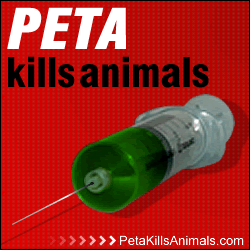
PETA to Local Shelter: "Kill More Animals"

Normally, People for the Ethical Treatment of Animals (PETA) – the latest entrant to the drone market – takes every media hit it can performing stunts to oppose the killing of animals. Whether for clothing, eating or curing AIDS, you can be sure PETA "lettuce ladies" will be out in force trying to stop the use of animals.

However, when it comes to homeless pets, PETA doesn't mind the killing of animals; in fact, PETA itself kills dogs and cats wholesale. State regulatory filings show that PETA killed just shy of 30,000 pets since 1998.

And if you're an animal shelter trying to kill fewer pets, PETA will try to shame you into killing more. No, seriously – PETA sent activists to shoot undercover videos of shelters in New York State to make the case for more shelter pet killing. PETA is very efficient at shelter pet killing – those state records show that last year, PETA killed nearly 90% of the pets in its care. And PETA employees killed pets that court records in a North Carolina trial showed that they called "adorable" and "perfect."

PETA's stance isn't new: PETA wrote to a Florida newspaper that reducing shelter killing was foolish and only a "no-birth" pet community was acceptable. PETA argued feverishly against a proposed ordinance in its hometown of Norfolk, Virginia that would reduce euthanasia at the city pound.

So why might PETA be so vested in pet killing? The world's most ridiculous animal liberation organization claims mercy as its motive, but there's plenty of evidence that that's simply a cover story. In addition to the North Carolina evidence, a recent report from Britain suggests that there is dissent within PETA over the puppy-killing program's appropriateness. Also, other supposedly "death's door" pets picked up in PETA's backyard but sent to other shelters are living and thriving, no thanks to PETA's syringe.

But to PETA, animals living and thriving in human care might actually be a fate worse than death. An attorney representing PETA argued as much in open court about elephants being brought to zoos. PETA President Ingrid Newkirk has said that, in her vegan utopia, pets "would be phased out." Whether it is PETA's intent or not, PETA's animal shelter is keeping up its part of that desired phase-out.

Source: http://www.consumerfreedom.com/2013/04/peta-to-local-shelter-kill-more-animals/
Copyright © 2013 Center for Consumer Freedom


Also, see:

    Digg Technorati Delicious StumbleUpon Reddit BlinkList Furl Mixx Facebook Google Bookmark Yahoo
    Read more...

    How Well is Your Dog Groomed?  

    Posted by — Kim in , , , , ,

    Here's a great article that I thought I would pass on...hope you find it interesting! –Kim

    How to Groom Your Dog at Home

    The reason one should groom his/her dog is simple – your dog's physical state influences the way he feels and the way you look at your dog. Extreme cases, where lack of proper care, cleaning and grooming can directly affect the behavior of your dog, are not rare.

    Proper grooming not only infuses a healthy glow to your dog's appearance, but also helps develop his self-esteem; while it makes you a very proud parent, when you show off your dog to others.

    The first step involved in dog grooming is: Brushing!
     
    Brushing has been universally acknowledged by expert dog groomers as the single most important step in grooming.
     
    The benefits of brushing are many. To name a few:

    • Better blood circulation
    • Shinier and healthier coat
    • Better bonding
       
    Even if you know how crucial brushing is for your dog's health and well-being, we all know that there is a right way and a wrong way of doing anything. And without doubt, you would like to do everything the RIGHT way when it comes to your dog.

    Yes, there's a method to follow while brushing your dog.

    Here are FIVE steps to successfully brushing your dog that will prove to be extremely useful:

    • Brush against the growth of the hair first with a slicker brush and then with a medium or wide-toothed comb.
    • The slicker brush removes all the loose hair and the comb takes care of the tangles.
    • Brush your dog along the hair growth and make sure you reach the skin as you brush his way.
    • Then use a flea comb over the coat to get the fleas and remove any remaining tangles. Part the coat and start from the root and then comb through.
    • If your dog's paw pads are hairy, then clip them using electric clippers. Do not clip the hair in between the pads. Clip only the excess hair.
       
    Brush your dog's hairs to prevent it from matting. Matting can be a very painful experience.

    Regular brushing untangles the matted hairs on your dog's coat. Since this is a risky job to do, the best way out is to prevent them from forming in the first place. And doing this is simple: just brush and comb your dog regularly. If and when you see any mats or tangles, use a detangle solution and a medium-toothed comb.

    Don't wait until your dog is dirty or matted to introduce him to grooming. That would make him associate the experience with unpleasantness. Moreover, many dogs learn to see their routine brushing as an alternate form of petting, i.e. another source of affection and attention.

    Subscribe to this FREE dog grooming mini course and start grooming your dog all by yourself right from the comfort of your home, today.

    Copyright © 2009 TrainPetDog.com
      

    Digg Technorati Delicious StumbleUpon Reddit BlinkList Furl Mixx Facebook Google Bookmark Yahoo
    Read more...

    Frozen Corgi Pandas  

    Posted by — Kim in , , , , , , , ,

    Here's a really cute video that I thought I would pass on... –Kim

    Can't move! We're stuck!

    These dogs in costume are not amused. You probably think dressing up your animal as another animal is adorable and hilarious, but did you ever ask your pets how they felt about it? These Corgis don't think it's all that funny, thank you very much.
     
    Source: http://www.youtube.com/watch?v=qqiE9CFJ4GI


    Also, see: How to Win a Costume Contest

    Digg Technorati Delicious StumbleUpon Reddit BlinkList Furl Mixx Facebook Google Bookmark Yahoo
    Read more...

    Tick Season is Here!  

    Posted by — Kim in , , , , , , , , , , , , , , ,

    It's tick season again... Take steps now to protect your pets! –Kim

    Exposure to Ehrlichia Ticks Increased Fourfold in 2012

    • According to a manufacturer of tests for tick-borne diseases, Ehrlichia exposures in 2012 were four times greater than in 2011. This means the tick that transmits the disease is gaining territory across the U.S.
    • The recommendation of the Companion Animal Parasite Council is to load up every dog and cat across the country with monthly, year-round chemical pesticides. The problem is, more and more pets taking monthly, year-in/year-out preventives are showing up in veterinary clinics with tick-borne illness. Clearly, encouraging the overuse of these chemicals isn't the best solution to the problem, for a number of reasons.
    • Chemical tick preventives may reduce – but not prevent – tick attachment. And any tick that attaches to your dog can carry disease. So theses pesticides are not foolproof, but they do add to your pet's toxic load.
    • The safest and most effective tick prevention strategy is to check your pet's body daily for ticks, remove them immediately and safely when found, and have his blood checked regularly for signs of infection.

    By Dr. Becker
    January 18, 2013
     
    Last year, toward the end of flea/tick season, IDEXX Laboratories (maker of the SNAP 4Dx test for tick-borne diseases) issued a press release to report there were four times as many Ehrlichia exposures in 2012 vs. 2011 in the south central and eastern regions of the U.S. (Ehrlichia is one of several tick-borne diseases.)

    And of course the veterinary community is now being prompted by the Companion Animal Parasite Council – which boasts as sponsors no less than 11 veterinary drug manufacturers and laboratories – to respond in the usual way. From dvm360:
    In order to keep that [the spreading Ehrlichia exposure] threat to a minimum, [Dr. Susan] Little suggests that veterinarians follow the Companion Animal Parasite Council's recommendations and urge clients to practice year-round tick control and prevention. "We need to be more adamant with clients about year-round tick control for dogs and cats," Little says. "Tick control protects dogs and cats from tick-borne diseases – the ones we know about and the ones we're still finding out about."
    Translation: Veterinarians should increase the pressure on pet owners to give tick preventives year-round, and not only to dogs, but also to cats. It doesn't matter where the pet lives, his lifestyle, or whether he even goes outdoors – just load him up with chemical pesticides and all will be well.
    Before you subject your own pet to year-round chemical preventives that may not be necessary or terribly effective, but WILL add significantly to your dog's toxic load, you should read on.

    Why Tick-borne Diseases are on the Rise

    As I discussed last July in an article about my own dogs and tick-borne illness, there are several reasons for the increase in tick-related diseases across the U.S.
    As we are discovering, ticks are hardy little suckers able to expand their geography from one region of the country to others.
    In addition, in my opinion we've overused progressively more toxic tick control agents for several decades, with the result that ticks have developed resistance to pesticides. I see dogs in my practice that have received monthly doses of pesticides for years, yet they still test positive for tick-borne illness.
    This is because while chemical preventives may reduce the number of ticks that wind up on your dog, those that do attach can still carry disease. So the pesticides being given at ever-increasing rates to our pets are not completely effective at preventing ticks from attaching or preventing disease.
    Another reason tick-borne diseases are on the rise is that insects other than ticks – specifically mosquitoes have been found to transmit some of these potentially lethal infections.
    Human management of wildlife populations, as well as a shift in wildlife population dynamics may also play into rising tick-borne diseases.

    Diagnosing Ehrlichiosis

    Canine ehrlichiosis is a tick-borne disease caused by two bacteria. Ehrlichia canis is transmitted by the brown dog tick and is commonly found in the southwest and Gulf Coast states. Ehrlichia ewingii is transmitted by the lone star tick and is found from the Midwest to New England.
    Like other tick-borne diseases, Ehrlichia can wreak havoc on your dog's body if it's not identified and treated. Symptoms can be vague – loss of appetite, low-grade fever, lethargy, swollen lymph nodes. Sometimes there are more noticeable symptoms such as unexplained bruising, lameness or nosebleeds.
    A diagnosis can be confirmed with a blood test called a PCR. If your dog tests positive on the SNAP 4Dx screening test for Ehrlichia, you can request a PCR test to confirm infection.
    Keep in mind that just because a dog tests positive on the initial screening test doesn't mean she must immediately be treated. In fact, most dogs successfully clear their own infections without the need for medical intervention. For this reason, I don't recommend automatically giving antibiotics to positive dogs.
    If your pet tests positive, ask your vet to do additional testing to find out whether she has just been exposed or is actually dealing with an infection.

    Tips for Preventing a Tick-borne Infection

    • When flea and tick season arrives, check for ticks daily, and don't overlook areas of your pet's body where ticks can hide, like between the toes, the underside of the toes, in the earflaps and around the tail base. If you're ever unsure whether you're looking at a tick or some other bump on your dog, get out a magnifying glass and look for the telltale sign of a tick – legs.
    • Remember that ticks must be attached to your dog for at least 24 hours in order for the disease-causing bacteria to be transmitted from the tick to your pet. That's why daily tick checks and removing ticks immediately is a huge part of reducing your dog's risk of acquiring a tick-borne disease. This is hands-down the safest and entirely non-toxic method of tick prevention!
    • If you find a tick on your dog, be sure to remove it correctly. Don't use your bare hands. People can become infected by handling or crushing an infected tick. Wear gloves, or even better, use a tick-removing tool.
    • Grasp the tick very close to your pet's skin with our Tick Stick, a similar tick removal tool, or a pair of tweezers. Carefully pull the tick's body away from the skin. Once it's off, flush it down the toilet. Then disinfect your dog's skin with soapy water or diluted povidone iodine (Betadine). Disinfect the area really well and monitor it for the next few days. If you notice any irritation or inflammation of the skin, you should contact your veterinarian.
    • Have your dog tested for tick-borne diseases about three to four weeks after removing a tick. The type of test to ask your vet for is the SNAP 4Dx test, which is a screening blood test. If you don't have the 4Dx test done, you'll want to watch your dog closely for several months for any signs of loss of appetite, lethargy, changes in gait, fever, intermittent limping – all the symptoms of potential tick-borne diseases.
    Checking your dog externally for ticks and having his blood checked regularly for internal, silent infections is the very best approach to keeping your pet safe from potentially devastating tick-borne diseases.

    Source: http://healthypets.mercola.com/sites/healthypets/archive/2013/01/18/tick-borne-diseases.aspx
    © Copyright 1997-2013 Dr. Joseph Mercola

    Also, see:

      Digg Technorati Delicious StumbleUpon Reddit BlinkList Furl Mixx Facebook Google Bookmark Yahoo
      Read more...

      Dog Bites BPA & BPS  

      Posted by — Kim in , , , , , , , , , , , , , , , , , , ,

      Having lost a dear companion to cancer from BPA toys, this topic is very important to me. –Kim

      Chemicals Leak from Plastic Training Toys

      Dogs that chew on plastic training devices and toys may be exposed to hormone-altering chemicals, according to research at Texas Tech University. Bisphenol A (BPA) and phthalates – ingredients of hard plastics and vinyl – readily leach from bumper toys, which are used to train retrieving dogs. But Bisphenol S (BPS), the chemical now being used in place of BPA in many "BPA-free" products, may be just as harmful – if not more harmful – than BPA.

      The new study is one of the first to examine dog products as a potential source of exposure for pets. No one knows, though, whether the traces of the chemicals pose any health risk to dogs. "Some of the dogs are exposed to plastic bumpers from the time they are born until the day they die. We all want our pets to be healthy," said toxicologist Philip Smith, co-author of the as-yet unpublished study.

      By Lindsey Konkel
      Environmental Health News
      Nov. 29, 2012

      Dogs that chew on plastic training devices and toys may be exposed to hormone-altering chemicals, according to research at Texas Tech University.

      The researchers found that bisphenol A (BPA), Bisphenol S (BPS) and phthalates – ingredients of hard plastics and vinyl – readily leach from bumper toys, which are used to train retrieving dogs.

      The new study is one of the first to examine dog products as a potential source of exposure for pets. No one knows, though, whether the traces of the chemicals pose any health risk to dogs. Previous research has focused on the risks to infants and toddlers from baby bottles, toys and other items that contained the chemicals.

      "A lot of plastic products are used for dogs, so to understand the potential for some of the chemicals to leach out from toys is a new and important area of research," said veterinarian Safdar Khan, senior director of toxicology research at the ASPCA's Poison Control Center in Illinois. Dr. Khan was not involved in the current study.

      Philip Smith, a toxicologist at The Institute of Environmental and Human Health at Texas Tech, became interested in chemical exposures from bumpers after using them to train his own Labrador retrievers.

      Retrieving dogs often are trained with plastic bumpers,
      which when chewed can leach hormone-disrupting chemicals.
      "Some of the dogs are exposed to plastic bumpers from the time they are born until the day they die. We all want our pets to be healthy," said Smith, co-author of the as-yet unpublished study, which was presented this month at the Society of Environmental Toxicology and Chemistry conference in California.

      "A lot of plastic products are used for dogs, so to understand the potential for some of the chemicals to leach out from toys is a new and important area of research," stated Dr. Safdar Khan.

      In humans and rodents, BPA, BPS and phthalates have been linked to a number of health issues, including impaired development of reproductive organs, decreased fertility and cancers. The United States and the European Union have banned some phthalates in children's toys, and in July, the U.S. Food and Drug Administration banned BPA in baby bottles and sippy cups.

      The researchers, led by Kimberly Wooten, a graduate student in environmental toxicology at Texas Tech, studied factors that affected how much BPA, BPS and phthalates leached from plastic bumpers into dishes filled with artificial dog saliva.

      They tested orange and white bumpers from two unidentified makers. The bumpers subjected to simulated chewing leached more BPA, BPS and phthalates than brand new bumpers and those left outside to weather for a month.

      Researchers said they suspect that the levels of chemicals observed from the bumpers would be considered very high when compared with children's toys.

      Since simulated saliva was used, it is difficult to say how much actual leaching would occur in a dog's mouth, the researchers said. "We don't have enough information at this time to begin to estimate actual exposure," Smith said.

      Smith said they suspect that the levels of chemicals observed from the bumpers would be considered very high when compared with children's toys.

      Using artificial saliva, researchers
      simulated a dog chewing a bumper.
      The researchers also looked at phthalates, BPA and BPS from pet toys sold through major retailers. They found higher concentrations leaching from bumpers than from other toys but preliminary results suggest some store-bought toys might have leached other hormonally-active chemicals.
      A previous study by the Environmental Working Group found that dogs' blood and urine contained the breakdown products of several phthalates at levels ranging from 1.1 to 4.5 times higher than the average found in people.

      "Dogs are closer to the ground than humans, so house dust is another potential source of exposure to environmental chemicals," Dr. Khan said.

      But little is known about any potential health risks for dogs exposed to hormone-mimicking chemicals.

      Since little toxicity data exist for dogs, it is difficult to evaluate risks, Smith said. Nonetheless, "consumer education about potential risk seems to be warranted based on our data," he said.

      Source: Environmental Health News
      Copyright © 2011-2012 Environmental Health Sciences


      Also, see:

        Digg Technorati Delicious StumbleUpon Reddit BlinkList Furl Mixx Facebook Google Bookmark Yahoo
        Read more...

        Dog Food Secrets  

        Posted by — Kim in , , , , , , , , , , , , ,

        Valuable Resource...
         
        Urgent Press Release for Dog Owners


        You're about to discover the terrifying-truth about commercial dog food that is linked to the deaths of thousands of dogs across the US every single day.

        Many world-famous Doctors of Veterinary Medicine and published Dog Care Experts universally agree. Any dog that eats commercial dog food is at a much higher risk of dying prematurely. And by the time symptoms are noticeable, it's often too late to prevent an agonizing death except by lethal injection.

        See their shocking, research-supported claims in this report.

        Also in this report, I show you a simple solution proven to increase the lifespan of your dog by up to 134% and save you up to $10,000.

        To discover these amazing secrets, just continue reading and your reward is a super-healthy, incredibly happy dog that stays by-your-side for up to 8.3 years longer than statistically predicted.


        Let's continue with this critical information...

        "Commercial Dog Food is Killing Your Dog;
        Hear What the Experts Have to Say..."

        Continued - Click for more vital information....

        Digg Technorati Delicious StumbleUpon Reddit BlinkList Furl Mixx Facebook Google Bookmark Yahoo
        Read more...

        Lost Dogs of the NYCACC  

        Posted by — Kim in , , , , , , , , , , , , ,

        Here's a sad video about the plight of many good dogs under government "care & control." –Kim

        A Tribute to Some of the Lost Dogs at the NYC Animal Care & Control

        Source: https://www.youtube.com/watch?v=krPblKdlsfc


        Also, see:

        Digg Technorati Delicious StumbleUpon Reddit BlinkList Furl Mixx Facebook Google Bookmark Yahoo
        Read more...

        To Save Animals, You Have to Like People  

        Posted by — Kim in , , , , , , , , ,

        Here's a great article that I thought I would pass on...hope you find it interesting! –Kim

        To Save Animals, You Have to Like People

        by Anne Reed
        Feb. 25, 2013

        "Boy, I hate people."

        I hear that all the time from people who work in animal welfare. I disagree.

        I understand why they feel that way. When you do this work, you hear stories all the time that make you angry. Abuse and neglect. Domestic violence. Well-meaning stupidity. Even the simple failure to stick with commitments: "I'm moving out of town, so I need to surrender my 12-year-old dog."

        These stories would make anyone mad, let alone someone who cares enough about animals to have chosen shelter work over other, almost certainly better-paying, options.

        But here's the catch, and it's a big one. The only way you can save homeless animals is by liking people. By trusting people, welcoming people, inspiring people, and helping people keep their own animals and adopt more.

        This insight is the core of a fundamental shift in animal welfare work in recent years. Like most powerful insights, it grabs you the minute you get it. Think about it: can you save the lives of more animals....
        • By screening adopters strictly and allowing only the most qualified, or by believing that most people can give an animal a loving home?
        • By creating obstacles to adopting an animal that only the most dedicated family can surmount (long waits, home inspections, special requirements), or by making it easy to bring a homeless animal into one's life?
        • By assuming every animal is better off in the shelter than staying with someone who is thinking about giving them up, or by working with families to find ways they can keep their animals?
        Our shelter helped develop this approach, and now we are among many who follow it. We still get criticism sometimes from those who think we should make it more difficult to adopt an animal – but our low return rates, the great stories we hear from our adopters, the follow-up we provide for them, and the number of times we do decline to adopt all make us confident that the approach works.

        Liking people has saved hundreds of thousands of animals' lives across the country.

        Shelby the Pomeranian
        Here's one more thing that happens when an animal shelter decides to like people: we find compassion for some of the things that made us angry in the first place. Not all, but many. The family whose dog's behavior problems got worse after they used an electric shock collar; they had the wrong information, and they didn't know. The couple who doesn't think they're giving their dog enough attention now that they've had a baby; they're exhausted, and worried. The family who is moving; they've both lost their jobs, and don't know what lies ahead.

        From this place of compassion, we find that we often can actually help them, and help their animals. When we're not judging people, we can find ways to open their minds to possibilities and ideas.

        The only way to help animals is to like people.

        (Our pro-people approach is especially helpful when we need to find a home for an animal with special challenges, like adorable Shelby, in the picture. She's unbelievably cute, but easily stressed, so we have her in a foster home, instead of in the shelter, and it will take longer for her to find an adoptive family there. Our pro-adoption philosophy is one of the key tools that allows us to give her, and every animal in our adoption program, as long as it takes.)

        Source: http://www.onmilwaukee.com/myOMC/authors/annereed/wihumaneblogshelby.html


        Anne Reed is the Executive Director of the Wisconsin Humane Society. Before joining WHS, Anne spent almost three decades as a corporate litigator. As a lawyer, she was named one of the Wisconsin Law Journal's "Women In The Law" and was named to the list of "Wisconsin Superlawyers." WHS operates shelters in Milwaukee, Saukville and Racine.


        Also, see:
        Good Homes Need Not Apply

        Digg Technorati Delicious StumbleUpon Reddit BlinkList Furl Mixx Facebook Google Bookmark Yahoo
        Read more...

        Another Pet Food Recall  

        Posted by — Kim in , , , , , , , , , , , , ,

        Here's another pet food recall alert. –Kim

        P&G Natura Pet Voluntary Recall

        Natura Pet has confirmed they are recalling at least 20 pet food products affecting dogs, cats, and ferrets. We heard a rumor that Natura was having a major recall due to possible salmonella contamination. After spending half an hour on hold with them, a friendly representative finally confirmed the recall and gave us the list. Why they don't have a readily available press release on their website or through the FDA, we don't know.

        The products listed below may be contaminated with salmonella. These products appear to be distributed nationwide through Petco, various online retailers and local businesses. This is shaping up to be a large recall. Please spread the word. Like Healing Springs Animal Hospital on Facebook for the latest pet health & safety updates.

        This is not the first negative news since Proctor & Gamble purchased Natura Pet in 2010. In 2011, Natura Pet settled a $2.15 million class action lawsuit for allegedly overstating the quality of their ingredients. The lawsuit was started in 2009, one year before Proctor & Gamble became involved with Natura Pet.

        The recall affects the products named below that also have an expiration date between 12/17/13 and 1/2/14. If you have products possibly contaminated with salmonella, you should discontinue use. You can contact the company (800) 532-7261 between 8 a.m. and 5:30 p.m. (CST) Monday – Friday.

        The company now has an official press release on their Web site.
        Healthwise:
        • Weight Control
        • Puppy
        • Lamb & Oatmeal

        California Naturals:
        • Kangaroo & Red Lentil

        Innova:
        • All three cat formulas
        • Puppy
        • Adult large bite
        • Senior plus
        • Prime beef & lamb
        • Herring & Salmon
        • Herring
        • Large breed adult & puppy

        Evo:
        • Ferret
        • Turkey & Chicken Cat & Kitten
        • Herring & Salmon Cat food
        • Red Meat Large Bites Dog
        • Turkey & Chicken - Dog
        • Senior
        • Weight Management
        Source: Food.com
        © 2013 Scripps Networks, LLC


        Replacement Product Information

        If your product is affected, and you would like a replacement, please download this form (PDF) and follow the instructions.

        Updated Press Information
        Download official Press Release (PDF)

        More info:
        EVO, Innova, California Natural and HealthWise Dog Food Recall

        Digg Technorati Delicious StumbleUpon Reddit BlinkList Furl Mixx Facebook Google Bookmark Yahoo
        Read more...

        Clicker-training: The Highly Effective Method Used by Many Professional Dog Trainers  

        Posted by — Kim in , , , , , , , , , , ,

        Valuable Resource...

        The 4 Secrets of Becoming a Supertrainer...

        The following information may change the way you look at dog training forever.
        From Morten Egtvedt & Cecilie Koeste
         
        Dear Fellow Dog Trainer,
        Did you know that there are FOUR important secrets about training dogs (or any other animals), that can make YOU capable of solving every behavior problem you will ever meet – and teach any new behavior or trick you can imagine?

        Did you know that regardless of whether you have just gotten your first puppy or whether you are already an experienced dog owner or trainer – learning these secrets could change your life?

        Did you know that everything you have heard about clicker training until now may be just the tip of the iceberg?

        Did you know that most people using clicker training today never really unleash the full potential of this powerful technology?

        Well, that is going to change for you, my friend...

        ...as soon as you learn the 4 Secrets of Becoming a Supertrainer.

        Meet Emma. She is the kind of dog trainer who is able to solve ANY kind of dog problem. No matter what kind of dog, no matter what kind of behavior problem. Emma knows exactly how to analyze the problem, design a training plan and fix it. And dogs just love her!

        Emma used to be just like most other dog owners. She believed that advanced dog training was only for experts with special talents (you know, like the "dog whisperers" on TV).

        But then Emma learned about Clicker Training and the 4 Secrets of Becoming a Supertrainer. And when you know these secrets your life changes. Because now you always know where to look for solutions when you want to fix a problem, teach a new behavior or improve your training.

        When YOU learn these 4 secrets you too will be ready to face ANY training challenge. And just like Emma you will be laughing at "dog whisperers" with all their superstitious explanations.

        Because you will know that dog training is not magic – it's SCIENCE. And everyone can learn these scientific principles and use them effectively in their training.


        So, where do I learn more about these secrets?
        Click here for more information!

        Digg Technorati Delicious StumbleUpon Reddit BlinkList Furl Mixx Facebook Google Bookmark Yahoo
        Read more...

        Don’t Neuter Your Dog... YET  

        Posted by — Kim in , , , , , , , , , , , , , , , , , , ,

        Here's a great article that I thought I would pass on...hope you find it interesting! –Kim

        Don't Neuter Your Dog YET –
        Read this Life-Saving Information First!

        by Dr. Karen Becker
        February 17, 2011

        A very legitimate concern, pet overpopulation, has been the primary driving force behind 30 years of national and local spay/neuter campaigns.
        When it comes to deciding at what age a companion animal should be sterilized, the standard for most spay/neuter campaigns has been sooner rather than later. This is especially true in the case of adoptable abandoned and rescued pets that wind up in shelters and foster care.
        Recently, however, some animal health care experts have begun to question whether early sterilization is a good idea for every pet.
        Dr. Alice Villalobos, a well-known pioneer in the field of cancer care for companion animals, asks the question:
        "But what if large-scale studies found that early neutering jeopardizes the health of our pets?"
        "What if we found enough epidemiological evidence that early neutering of pet dogs may open them to orthopedic, behavioral, immunologic and oncologic issues?"
        Back in 1977, Dr. Villalobos founded a rescue organization called the Peter Zippi Fund for Animals, which has to date rescued and re-homed nearly 12,000 pets. Her organization was one of thousands that looked at the tragic situation in U.S. shelters and determined early spay/neuter was the best way to lessen the suffering and ultimate euthanasia of so many feral and abandoned animals.
        As a veterinary oncologist and founder of the pet hospice program Pawspice, Dr. Villalobos concedes, "It is earth shattering to consider that some of the cancers we have been battling may have been enhanced by early neutering instead of the reverse."
         
        Dr. Becker's Comments:
        It's unfortunately true that a growing body of research is pointing to early sterilization as the common denominator for development of several debilitating and life-threatening canine diseases.
        On one hand, we certainly want to know what's causing our precious canine companions to develop disease. On the other hand, it's troubling to learn a procedure we've historically viewed as life-saving and of value to the pet community as a whole, has likely played a role in harming the health of some of the very animals we set out to protect.
        The same amount of evidence has not been compiled for early spay/neuter of cats, but it's not clear how well the subject is being studied for kitties. Funding for research into feline health issues falls well below dollars allocated for their canine counterparts.

        Cardiac Tumors

        A Veterinary Medical Database search of the years 1982 to 1995 revealed that in dogs with tumors of the heart, the relative risk for spayed females was over four times that of intact females.
        For the most common type of cardiac tumor, hemangiosarcoma (HAS), spayed females had a greater than five times risk vs. their intact counterparts. Neutered male dogs had a slightly higher risk than intact males.
        The study concluded that, "…neutering appeared to increase the risk of cardiac tumor in both sexes. Intact females were least likely to develop a cardiac tumor, whereas spayed females were most likely to develop a tumor. Twelve breeds had greater than average risk of developing a cardiac tumor, whereas 17 had lower risk."

        Bone Cancer

        In a study of Rottweilers published in 2002, it was established the risk for bone sarcoma was significantly influenced by the age at which the dogs were sterilized.
        For both male and female Rotties spayed or neutered before one year of age, there was a one in four lifetime risk for bone cancer, and the sterilized animals were significantly more likely to develop the disease than intact dogs of the same breed.
        In another study using the Veterinary Medical Database for the period 1980 through 1994, it was concluded the risk for bone cancer in large breed, purebred dogs increased twofold for those dogs that were also sterilized.

        Prostate Cancer

        It's commonly believed that neutering a male dog will prevent prostatic carcinoma (PC) – cancer of the prostate gland.
        But worthy of note is that according to one study conducted at the College of Veterinary Medicine at Michigan State University, "…castration at any age showed no sparing effect on the risk of development of PC in the dog."
        This was a small study of just 43 animals, however. And researchers conceded the development of prostate cancer in dogs may not be exclusively related to the hormones produced by the testicles. Preliminary work indicates non-testicular androgens exert a significant influence on the canine prostate.

        Abnormal Bone Growth and Development

        Studies done in the 1990's concluded dogs spayed or neutered under one year of age grew significantly taller than non-sterilized dogs or those not spayed/neutered until after puberty. And the earlier the spay/neuter procedure, the taller the dog.
        Research published in 2000 in the Journal of Pediatric Endocrinology and Metabolism may explain why dogs sterilized before puberty are inclined to grow abnormally:
        At puberty, estrogen promotes skeletal maturation and the gradual, progressive closure of the epiphyseal growth plate, possibly as a consequence of both estrogen-induced vascular and osteoblastic invasion and the termination of chondrogenesis.
        In addition, during puberty and into the third decade, estrogen has an anabolic effect on the osteoblast and an apoptotic effect on the osteoclast, increasing bone mineral acquisition in axial and appendicular bone.
        It appears the removal of estrogen-producing organs in immature dogs, female and male, can cause growth plates to remain open. These animals continue to grow and wind up with abnormal growth patterns and bone structure. This results in irregular body proportions.
        According to Chris Zink, DVM:
        "For example, if the femur has achieved its genetically determined normal length at 8 months when a dog gets spayed or neutered, but the tibia, which normally stops growing at 12 to 14 months of age continues to grow, then an abnormal angle may develop at the stifle. In addition, with the extra growth, the lower leg below the stifle likely becomes heavier (because it is longer), and may cause increased stresses on the cranial cruciate ligament."

        Higher Rate of ACL Ruptures

        A study conducted at Texas Tech University Health Sciences Center on canine anterior cruciate ligament (ACL) injuries concluded that spayed and neutered dogs had a significantly higher incidence of ACL rupture than their intact counterparts. And while large breed dogs had more ACL injuries, sterilized dogs of all breeds and sizes had increased rupture rates.

        Hip Dysplasia

        In a retrospective cohort study conducted at Cornell University's College of Veterinary Medicine, and published in the Journal of the American Veterinary Medical Association, results showed that both male and female dogs sterilized at an early age were more prone to hip dysplasia.

        Other Early-Age Spay/Neuter Health Concerns

        Early gonad removal is commonly associated with urinary incontinence in female dogs and has been linked to increased incidence of urethral sphincter incontinence in males.
        Spayed and neutered Golden Retrievers are more likely to develop hypothyroidism.
        A cohort study of shelter dogs conducted by the College of Veterinary Medicine at Texas A&M University concluded that infectious diseases were more common in dogs that were sterilized at less than 24 weeks of age.
        The AKC's Canine Health Foundation issued a report pointing to a higher incidence of adverse reactions to vaccines in sterilized dogs.
        Among the reports and studies pointing to health concerns associated with early spaying and neutering, you can also find mention of increased incidence of behavioral problems including:
        • Noise phobias
        • Fearful behavior
        • Aggression
        • Undesirable sexual behaviors

        Risks versus Benefits of Early Sterilization

        Every important decision in life comes with risks as well as benefits.
        As responsible animal guardians, I believe we owe it to our pets to make the best health choices we can for them.
        As responsible members of society, we owe it to our communities to proactively protect our intact pets from unplanned breeding at all costs. We must hold ourselves to the highest standard of reproductive control over the intact animals we are responsible for.
        Clearly, there are health benefits to be derived from waiting until after puberty to spay or neuter your dog.
        However, there are also significant risks associated with owning an intact, maturing pet.
        • How seriously you take your responsibility as a pet owner is the biggest determining factor in how risky it is to leave your dog intact until he or she matures. If you are responsible enough to absolutely guarantee your unsterilized pet will not have the opportunity to mate, I would encourage you to wait until your pet is past puberty to spay or neuter.
        • If you are unable to absolutely guarantee you can prevent your dog from mating and adding to the shameful, tragic problem of pet overpopulation, then I strongly encourage you to get your animal sterilized as soon as it's safe to do so.
        Please note: I'm not advocating pet owners keep their dogs intact indefinitely (see below). I'm also not suggesting that shelters and rescues stop sterilizing young animals before re-homing them. Shelter organizations can't determine how responsible adoptive pet owners will be. In this situation, the risk of leaving adoptable animals intact is simply unacceptable. Shelters and rescues must immediately spay/neuter pets coming into their care.
        If you've adopted or rescued a dog sterilized at an early age, I encourage you to talk with your holistic veterinarian about any concerns you have for your pet's future well-being, and what steps you can take now to optimize her health throughout her life.
        There is no one perfect answer to the spay/neuter question that fits every pet, and each situation should be handled individually.

        For Responsible Pet Owners, Decisions about When to Spay or Neuter Should be Part of a Holistic Approach to Your Pet's Health and Quality of Life

        If you own an intact pet, I can offer a general guideline for timing a spay/neuter procedure. Your dog should be old enough to be a balanced individual both physically and mentally. This balance isn't achieved until a dog has reached at least one year of age. Although some breeds reach maturity faster than others, many giant breed dogs are still developing at two years of age.
        Other considerations include your dog's diet, level of exercise, behavioral habits, previous physical or emotional trauma, existing health concerns, and overall lifestyle.
        If you own an intact animal and need to make a spay/neuter decision, I encourage you to first learn all you can about surgical sterilization options and the risks and benefits associated with the procedures.
        Talk with reputable breeders and other experienced dog owners, and consult a holistic vet to understand what steps you can take to ensure the overall health and longevity of your pet.
         
        Source: http://healthypets.mercola.com/sites/healthypets/archive/2011/02/17/dangers-of-early-pet-spaying-or-neutering.aspx
        © Copyright 1997-2013 Dr. Joseph Mercola


        Digg Technorati Delicious StumbleUpon Reddit BlinkList Furl Mixx Facebook Google Bookmark Yahoo
        Read more...

        Canine Cancer  

        Posted by — Kim in , , , , , , , , , , ,

        Here's a great article that I thought I would pass on...hope you find it interesting! –Kim

        Do You Know the 10 Early Warning Signs?

        Love your dog? Learn the 10 L's of canine cancer.

        Lumps

        Not all lumps and bumps are cancerous in dogs. There are sebaceous cysts, lipomas and warts, all of which are benign. But if you detect a growth on your dog, it's important to have it checked out by a veterinarian and, if warranted, aspirated and biopsied.

        Lesions

        Scratches and abscesses are not uncommon for the normal, active dog but the sores that don't heal can be of concern.

        Lameness

        Bone cancer is typically found in larger breed dogs like Great Danes, Bernese Mountain dogs, Rottweilers, Boxers, Newfoundlands, Saint Bernards and Great Pyrenees, and the primary early indication is prolonged limping or favoring a limb or side. Other types of cancers can also cause persistent lameness.

        Loss of Appetite

        If your dog shows no interest in eating or their daily consumption has declined for several days, take them to a vet.

        Lethargy

        Tiring out easily, unwillingness to exercise and loss of interest in normal daily activities can be an early sign of cancer.

        Loss of Weight

        Not to be confused with loss of appetite. Cachexia, or emaciation, is often associated with cancer and can occur even if your dog is still eating normally. So if your dog is inexplicably losing weight, consult a veterinarian.

        Loud Odor

        A very strong and offensive smell can sometimes be a byproduct of tumors in the mouth and nasal cavity.

        Loss of Normal Body Functions

        Dogs having difficulty voiding or defecation or unusual urine or feces should be looked at.

        Loss of Blood, Bleeding or Bloody Discharge

        Blood present in vomit, stool, and nasal discharge are cause for serious concern and although not always telltale signs of cancer, your dog should be examined as soon as possible.

        Labored Breathing

        Abnormal respiration or respiratory distress can be a symptom of cancers in dogs.


        Get involved! To find out more about the 2 Million Dogs Foundation, our nationwide Walks, our yearly calendar, our other fund-raising events, and the research our efforts support, please visit our Web page. And please come join us on Facebook, follow the adventures of Hudson and Indy, and follow us on Twitter.

        Source: http://www.2milliondogs.org/page/16/blogs/2-million-dogs-blog
        Copyright 2010 2milliondogs.org


        Also, see:
        Why is There So Much Cancer?

        Digg Technorati Delicious StumbleUpon Reddit BlinkList Furl Mixx Facebook Google Bookmark Yahoo
        Read more...

        Bathtime Fun!  

        Posted by — Kim in , , , , , , , , ,

        Here's a really cute video that I thought I would pass on. –Kim

        Bathtime Fun! Super Cute


        Source: https://www.youtube.com/watch?v=GMuZdN84PJg


        Digg Technorati Delicious StumbleUpon Reddit BlinkList Furl Mixx Facebook Google Bookmark Yahoo
        Read more...

        Veterinary Secrets Revealed  

        Posted by — Kim in , , , , , , , , , , , , ,

        Valuable Resource...


        You CAN Heal Your Sick Pet at Home,
        Without Going to the Vet...

        In Less than 24 Hours, I Can Show You How to Examine, Diagnose and Treat Your Pet at Home.
        Dr. Andrew Jones, DVM

        Dear fellow pet lover,

        If you're not ready to make some simple changes to the way you provide veterinary care to your pet, beginning today....

        ...your dog or cat could be seriously ill and live a "shortened" life!

        Here is How I know:

        My dog died young, only 8 years old. He was a mixed breed dog, a specimen of health. He was given a ton of attention, exercised three times a day, fed only Veterinary Approved food, and given all his vaccines. He had the "ideal" life. Hoochie passed away in my arms from a massive tumor bleed at 12:02pm on April 12, 2003 – the saddest day of my life.

        I asked myself... why?

        I thought that he was incredibly healthy. I was sure I was doing all of the right things for him.

        But I later discovered I may have contributed to his death, because I believed ONLY in conventional veterinary medicine. You see, I am a Veterinarian.

        I'm Dr. Andrew Jones, and I have practiced Veterinary Medicine for over a decade. Over the past 17 years I have treated literally thousands of pets for a whole variety of problems, and I currently own the Nelson Animal Hospital in Nelson BC, Canada (http://www.nelsonvet.com). But, my beloved dog Hoochie is gone.

        You are fortunate... it's not too late for you and your pet. Just read on and find out exactly what you must do now.

        Pay Close Attention

        Conventional veterinary medicine may be harming your pet – and I can show you step-by-step what you must do to prevent it. "Regular" veterinary care has lost its effectiveness over the years, and in some cases is actually causing illness in our pets.

        Alternative pet health care has grown over the past few years, but the truth is that Veterinarians have STRONGLY discouraged pet owners from treating their pets outside of the Vet Clinic.

        The entire Pet Health Industry has a vested interest in discrediting alternative medicines which can safely, naturally and effectively allow pet owners to care for their pets at home.
        STOP AND READ THIS

        Lock the door, Unplug the phone, and do whatever you can to have 10 undivided minutes... Get ready to read about how you could be saving the life of your pet starting now!

        "I began to notice something unusual..."

        Slowly, I began to notice something unusual about Hoochie. He really just wasn't the same. He was reluctant to go for his morning dog walk, which was always the highlight of his day.
        I dismissed it as him feeling a bit off, some mild stomach issue or maybe a touch of arthritis... but it didn't pass. In fact, it got worse.

        I eventually did a blood test on Hoochie, thinking at that point that he had a tooth infection. However, much to my horror, I quickly found out that he had a spleen tumor.

        Immediately, I performed surgery on Hoochie and removed the spleen tumor. But I was too late - the cancer had already spread to his liver, and I knew that very soon, he would die.

        How did an apparently healthy mixed breed dog die so young?

        I did all the "right" things – or so I thought. After grieving, I came to realize that I had played a role in his dying at too young of an age.

        I came to question exactly what I did to my own pet – and what was I doing to other people's pets.

        Through my questioning, I came to realize that most Veterinarians (including me as well, at the time) are not "getting it" – that in the process of trying to heal pets through technological advances, we are actually making them sicker!

        There are 3 mistakes that I made that contributed to Hoochie's early death...

        ...are you making these same mistakes with your own dog?

        Click here to continue for more information!

        Digg Technorati Delicious StumbleUpon Reddit BlinkList Furl Mixx Facebook Google Bookmark Yahoo
        Read more...

        << – Newer Posts / Older Posts – >>

        List of No-kill Shelters and Rescues

        List of No-kill Shelters and Rescues: 
        NATIONAL SEARCH
        Find local shelters near you! LOCAL SEARCH
        You can adopt or foster from any of these shelters or donate to support their efforts. Be sure to confirm that they are a "no-kill" shelter. Then, be a part of the solution!

        << – Newer Posts / Older Posts – >>
        CLICK HERE FIRST; THEN CLICK THE PAGE LINK BELOW.